

Unmanaged Network Switches
If you’re looking for a simple, plug-and-play networking solution, Unmanaged Switches are a reliable choice for both home and small business use. These switches are designed to work straight out of the box—no complex configuration required. Whether you’re setting up a small office, adding devices to your home network, or just want a low-maintenance connection, an Unmanaged network switch offers ease, speed, and stability.



Key Features:
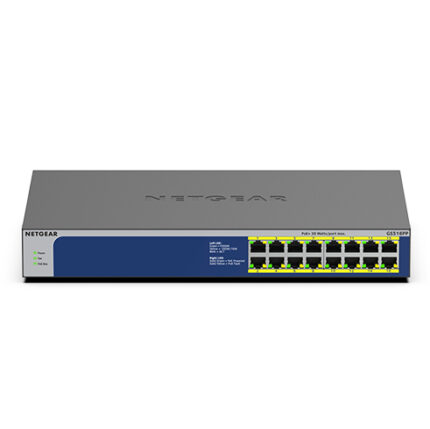
| Brand | Netgear |
| Product colour | Black |
| Mean time between failures (MTBF) | 2088514 h |
| Rack mounting | Yes |
| Switch type | Unmanaged |
| Quality of Service (QoS) support | Yes |
| Basic switching RJ-45 Ethernet ports type | Gigabit Ethernet (10/100/1000) |
| Gigabit Ethernet (copper) ports quantity | 16 |
| Networking standards | IEEE 802.1p, IEEE 802.3af, IEEE 802.3at, IEEE 802.3az, IEEE 802.3x |
| Flow control support | Yes |
| 10G support | No |
| MAC address table | 4000 entries |
| Switching capacity | 32 Gbit/s |
| Jumbo frames support | Yes |
| Certification | CE, FCC, ICES-003, VCCI, RCM, BSMI, KC, CB, CE LVD, BSMI, EAC, RCM, KC, EN 60950-1 |
| LED indicators | Yes |
| Power consumption (typical) | 90 W |
| Input current | 1.66 A |
| DC input voltage | 54 V |
| Power source | DC/PoE |
| Power over Ethernet plus (PoE+) ports quantity | 16 |
| Total Power over Ethernet (PoE) budget | 76 W |
| Power over Ethernet (PoE) | Yes |
| Storage temperature (T-T) | -20 - 70 °C |
| Storage relative humidity (H-H) | 0 - 95% |
| Operating temperature (T-T) | 0 - 40 °C |
| Operating relative humidity (H-H) | 0 - 90% |
| Operating altitude | 0 - 3000 m |
| Heat dissipation | 270.18 BTU/h |
| Width | 286 mm |
| Depth | 102 mm |
| Height | 27 mm |
| Weight | 880 g |
Incl. VAT: £157.79

Incl. VAT: £306.47
Why Choose Unmanaged Ethernet Switches?
Unmanaged Ethernet Switches are ideal for users who don’t need advanced settings like traffic prioritisation or VLAN support. They’re perfect for connecting multiple wired devices such as PCs, printers, and IP cameras without needing any IT expertise. Simply connect the power, plug in your Ethernet cables, and you're good to go.
Available in various port sizes—such as 8 port, 16 port, 24 port, or even 48 port—you can scale your network depending on your requirements. For example, a 48 port unmanaged switch is often used in growing office environments where many devices need consistent, stable connectivity.
PoE vs. Non-PoE Unmanaged Switches
Many users opt for PoE Switches (Power over Ethernet) when they want to power devices like IP cameras or wireless access points directly through the Ethernet cable, eliminating the need for separate power supplies. However, if your devices already have their own power sources, a Non PoE Switch can be a more cost-effective solution.
We stock both options in our Unmanaged Switch range, giving you the flexibility to choose what’s best for your setup.
Who Should Use Unmanaged Switches?
-
Home users looking to expand wired connectivity for media centers or work-from-home setups
-
Small offices needing fast, simple network expansion
-
Retail or warehouse environments that want hassle-free connectivity
-
Installers or IT resellers providing basic networking gear for clients without complex requirements
Frequently Asked Questions (FAQs)
Unmanaged switches are plug-and-play with no configuration required. Managed switches offer more control, such as traffic prioritisation, VLANs, and remote management.
Yes, especially if you choose an unmanaged PoE switch. It allows power and data to run through the same cable, which is ideal for security setups.
Not at all. Most modern unmanaged switches support Gigabit Ethernet, ensuring fast and stable performance for connected devices.
That depends on the port count. We offer 8 port, 16 port, 24 port, and 48 port unmanaged switches to support networks of all sizes.
If you’re connecting devices that require power (like IP cameras or VoIP phones), go for a PoE switch. Otherwise, a non-PoE switch is suitable for regular devices with their own power.