

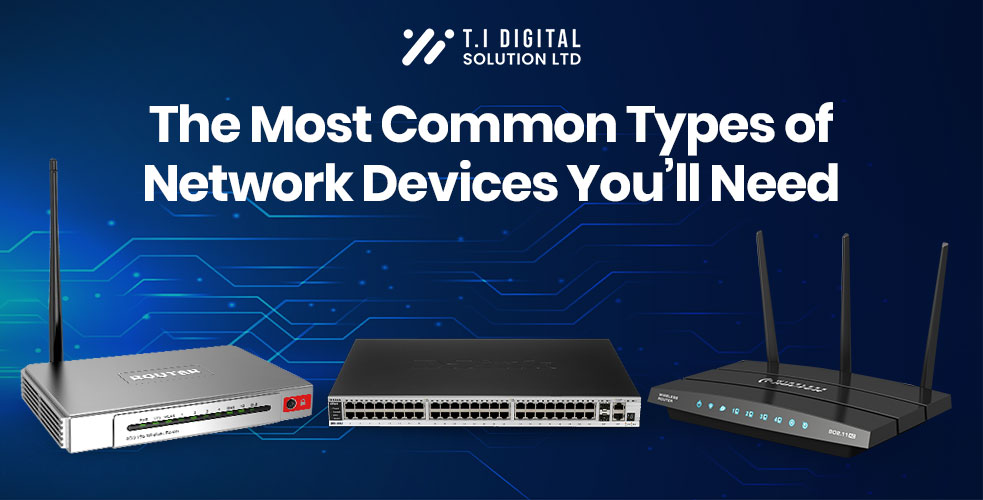
The Most Common Types of Network Devices You’ll Need

In today’s interconnected world, network devices play a crucial role in ensuring that data flows smoothly and efficiently between computers, servers, and other connected devices. Whether you’re setting up a small home network or managing a large enterprise infrastructure, understanding the different types of network devices is essential. This blog will explore the most common network devices you’ll need, the types of networks they support, and their functions.

What Are the Most Common Network Devices?

Network devices are the hardware components that connect computers and other devices together to share resources and information. Some of the most common network devices include:

  1. Router: A router is a device that forwards data packets between computer networks, directing the traffic on the internet. It connects multiple networks and routes data between them, ensuring that it reaches its intended destination.
  2. Switch: A switch connects devices within a single network, allowing them to communicate with each other. Unlike a hub, a switch only sends data to the device that needs it, making it more efficient.
  3. Hub: A hub is a basic networking device that connects multiple devices in a network, broadcasting data to all connected devices. While not as efficient as a switch, hubs are still used in some networks.
  4. Access Point (AP): An access point allows wireless devices to connect to a wired network using Wi-Fi. APs are commonly used to extend the coverage of a wireless network, providing connectivity in areas where a wired connection is impractical.
  5. Modem: A modem is a device that modulates and demodulates signals, allowing digital data to be transmitted over analog communication lines, such as telephone or cable lines.
  6. Firewall: A firewall is a security device that monitors and controls incoming and outgoing network traffic based on predetermined security rules. It acts as a barrier between your internal network and external networks, such as the internet.
  7. Network Interface Card (NIC): A NIC is a hardware component that allows a computer or other device to connect to a network. NICs can be built into the device or added as an expansion card.

These devices are foundational for setting up and maintaining a functional network, whether in a home, office, or larger enterprise environment.

What is the Most Common Network Type?

The most common network type in use today is the Local Area Network (LAN). A LAN connects devices within a limited area, such as a home, school, or office building. It is the most widely used network type because it is simple to set up and provides fast data transfer speeds. LANs can be connected to other LANs over larger geographic areas, forming a Wide Area Network (WAN), which is another common network type.

Specific Brands and Products

When selecting network devices, quality and reliability are crucial. We offer a range of top-tier network devices that cater to both home and enterprise needs. Here are some recommended products:

  • Ubiquiti U6-PRO: A high-performance access point designed to provide fast and reliable Wi-Fi connectivity for homes and businesses.
  • Ubiquiti U7-PRO: Another excellent access point from Ubiquiti, known for its extended range and robust performance in high-density environments.
  • Ubiquiti UAP-AC-PRO: Ideal for enterprise environments, this access point offers exceptional speed and coverage.
  • Ubiquiti U6-LR: A long-range access point perfect for large homes or offices that require extensive coverage.
  • Ubiquiti UAP-AC-M: A versatile access point that can be used indoors or outdoors, making it suitable for a wide range of applications.
  • Ubiquiti U6+: A newer model that provides enhanced performance and greater flexibility in network design.
  • Ubiquiti U6-MESH: Designed for seamless connectivity across multiple access points, this device is perfect for creating a robust mesh network.

Conclusion

Understanding the different types of network devices and their functions is essential for setting up and maintaining a reliable and efficient network. Whether you’re looking to connect a few devices in your home or manage a large-scale enterprise network, choosing the right devices is crucial. Explore our range of network products to find the perfect solutions for your needs, and ensure your network is built to last.

Leave a Reply

Your email address will not be published. Required fields are marked *