

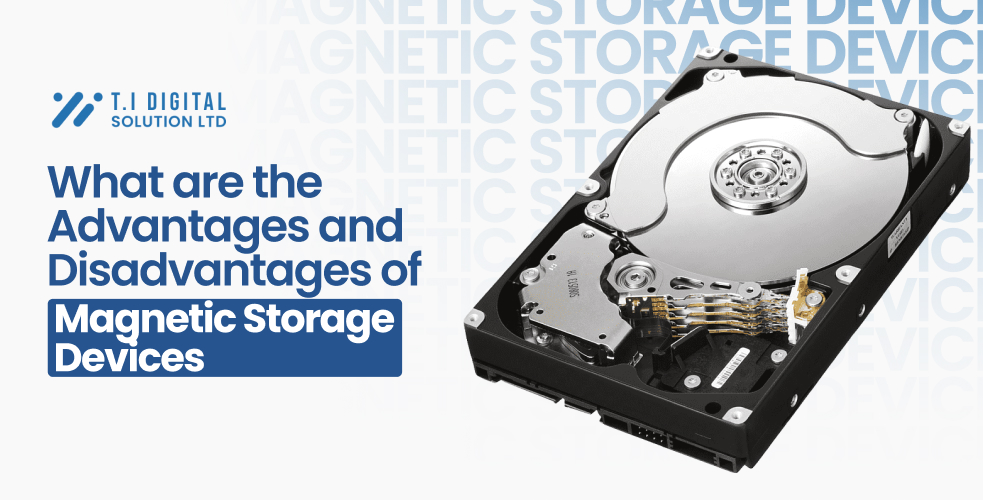
What are the Advantages and Disadvantages of Magnetic Storage Devices?

What are the Advantages and Disadvantages of Magnetic Storage Devices

Magnetic storage has been a cornerstone of data storage technology for decades, offering a balance of capacity, cost, and performance. It is commonly used in hard disk drives (HDDs) and is known for its reliability and affordability. However, like all technologies, it has its advantages and disadvantages.

Advantages of Magnetic Storage

  1. High Capacity: Magnetic storage devices, such as hard drives, are available in large capacities. For instance, a 16TB hard drive or a 20TB hard drive provides ample space for storing vast amounts of data, making them ideal for high-capacity needs such as data centers or surveillance systems.
  2. Cost-Effective: Magnetic storage is generally more affordable compared to other types of storage, such as solid-state drives (SSDs). This cost advantage is especially noticeable in larger capacities. A 3.5 hard disk drive or 4TB hard disk for CCTV offers a good balance of price and performance.
  3. Established Technology: The technology behind magnetic storage is well-established and reliable. It has been optimized over many years, making it a stable choice for many applications.
  4. High Write Durability: Magnetic storage devices, particularly traditional HDDs, can handle numerous read/write cycles without significant degradation, making them suitable for continuous and heavy use.

Disadvantages of Magnetic Storage

  1. Slower Speeds: Compared to newer storage technologies, such as SSDs, magnetic storage generally has slower data transfer speeds. While a 16TB hard drive provides large storage space, it may not match the speed of solid-state alternatives.
  2. Mechanical Parts: Hard drives contain moving parts, which makes them susceptible to mechanical failures. The read/write heads and spinning platters are prone to wear and tear, potentially leading to data loss if not handled properly.
  3. Size and Weight: Magnetic storage devices can be bulkier and heavier than their SSD counterparts. For example, a 3.5 hard disk drive is larger and heavier compared to a similarly-sized SSD, which can be a consideration in space-constrained environments.
  4. Power Consumption: Hard drives tend to consume more power compared to solid-state drives, which can be a factor in energy efficiency considerations for large-scale deployments.

What Is the Difference Between Magnetic and Optical Storage Devices?

Magnetic and optical storage devices use different methods for storing and retrieving data:

  • Magnetic Storage: Uses magnetic fields to encode data onto a medium such as a hard disk drive. Data is read and written by moving a read/write head over spinning platters coated with magnetic material. Magnetic storage is typically used in HDDs and is valued for its large storage capacities and cost-effectiveness.
  • Optical Storage: Uses laser technology to read and write data on optical discs such as CDs, DVDs, and Blu-ray discs. Data is stored in the form of tiny pits and lands on the disc surface, which are read by a laser beam. Optical storage is generally used for media distribution and archival purposes due to its portability and longevity.

Which Is Faster, Optical or Magnetic?

In general, magnetic storage devices, such as HDDs, are faster than optical storage devices. This is because magnetic storage devices can access and transfer data at higher speeds compared to optical drives, which have slower read/write speeds due to the nature of laser-based data retrieval. For instance, while a hard disk 16 TB can provide rapid access to large volumes of data, optical drives are typically slower and more suited for tasks like media playback rather than high-speed data access.

Conclusion

Magnetic storage offers substantial benefits in terms of capacity, cost, and durability, making it a popular choice for many applications. However, it also has limitations, including slower speeds and mechanical vulnerability. Understanding the differences between magnetic and optical storage can help you choose the right solution for your needs. Whether opting for a 4TB hard disk for CCTV or a 20TB hard drive for extensive data storage, magnetic storage remains a robust and reliable option for managing large volumes of information.

Leave a Reply

Your email address will not be published. Required fields are marked *